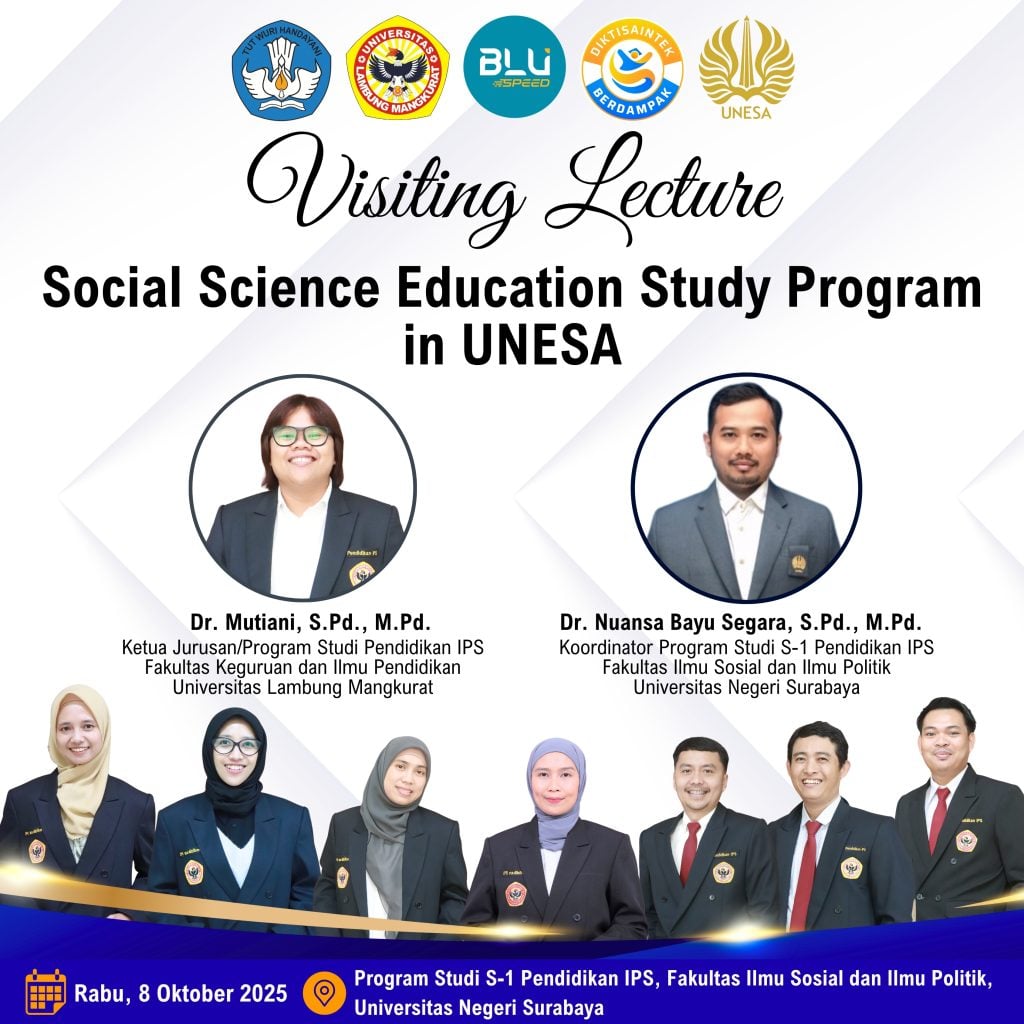
Visiting Lecture Social Science Education Study Program in UNESA
Visiting Lecture Social Science Education Study Program in UNESA
ULM–UNESA Strengthen Academic Collaboration through Visiting Lecture Series and Implementation Agreement Signing
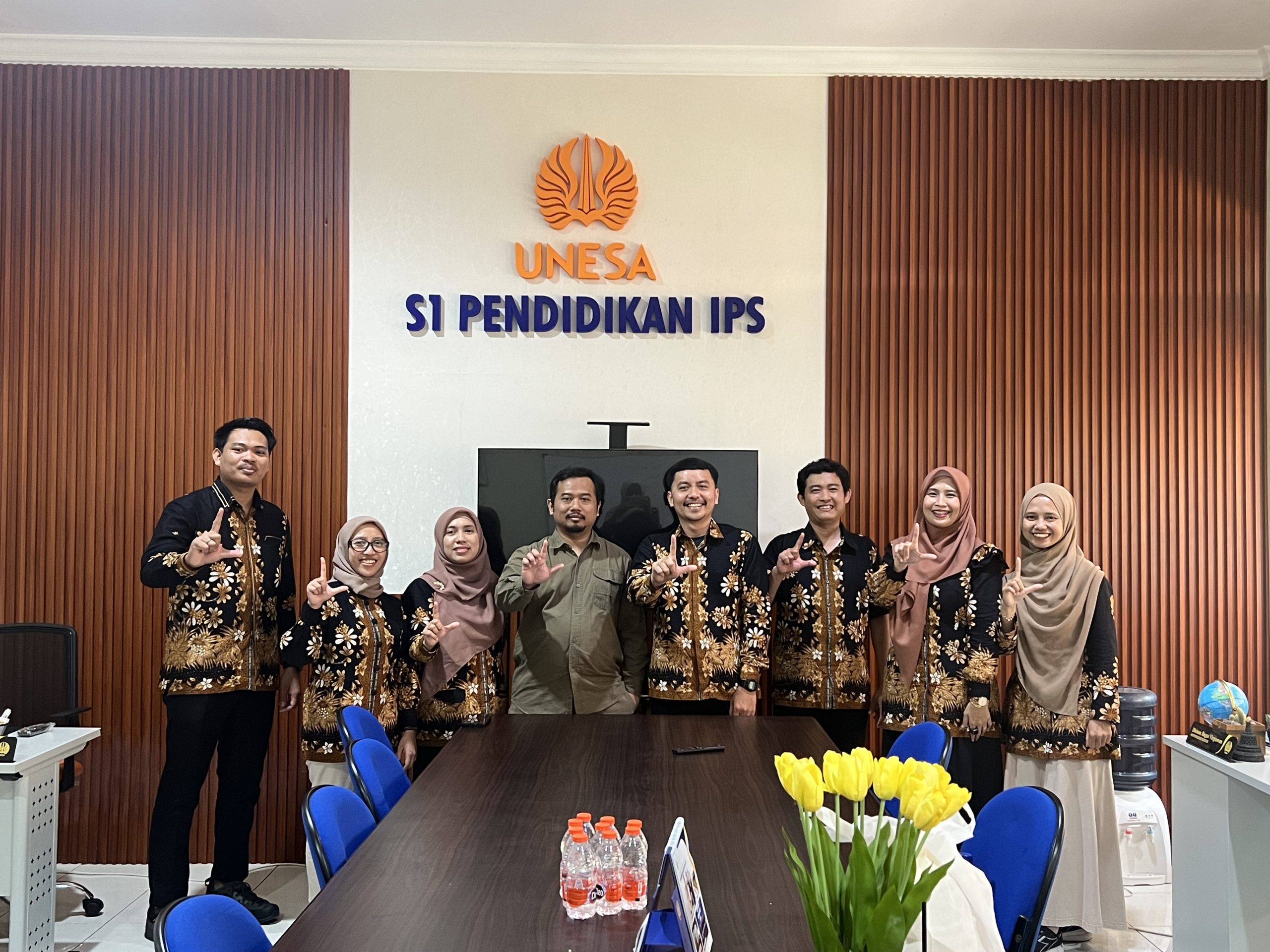
Surabaya, October 8, 2025 — The Department of Social Science Education, Faculty of Teacher Training and Education (FKIP), Universitas Lambung Mangkurat (ULM), and the Department of Social Science Education, Faculty of Social Sciences and Law (FISH), Universitas Negeri Surabaya (UNESA), officially strengthened their academic partnership through the signing of an Implementation Agreement (IA) and a series of Visiting Lectures held at the UNESA campus.
The event marked a milestone in inter-university collaboration aimed at enhancing academic quality, research innovation, and community engagement in the field of Social Science Education. The IA signing was attended by lecturers and students from both institutions, underscoring their shared commitment to advancing educational development based on social, cultural, and environmental values.
Implementation Agreement: A Step Forward in Academic Synergy
The IA builds upon a prior Memorandum of Understanding (MoU) between ULM and UNESA, covering joint initiatives such as visiting lectures, collaborative research, curriculum development, faculty exchanges, and joint scientific publications. Representatives from both universities emphasized that the partnership would serve as a model for sustainable academic networking in Indonesia.
“The synergy between UNESA and ULM not only enriches academic perspectives but also fosters the exchange of best practices in Social Science Education that respond to contemporary social challenges,” stated a UNESA representative.
Meanwhile, the ULM delegation highlighted that the collaboration reflects their dedication to preparing future social science educators capable of understanding complex social dynamics and promoting cultural and environmental awareness.
Enlightening Visiting Lecture Series
As part of the IA implementation, eight ULM lecturers were invited to deliver Visiting Lectures to UNESA students. Each session brought a unique theme aligned with the mission of fostering interdisciplinary and globally minded Social Science Education.
Dr. Raihanah Sari, S.Pd., M.Pd. discussed “Macroeconomic and Microeconomic Issues in the Perspective of ESD for Local Green Economy,” explaining how sustainable economic practices and local wisdom—such as eco-friendly purun straws in South Kalimantan—can enhance community welfare while preserving the environment.
Rusmaniah, S.Pd., M.Pd. delivered a lecture on “Environment as a Shaper of Cultural Identity,” emphasizing that nature is not merely a backdrop for human life but a key determinant of cultural values and social behavior. She encouraged students to view environmental awareness as part of cultural preservation.
Syarifuddin, S.Pd., M.Pd. presented insights on “Life in Peatland Areas,” highlighting the adaptive knowledge and traditions of Kalimantan’s peatland communities. He also appeared on the Siniar Podcast of UNESA’s Social Science Education Program, discussing the sustainability of Kalimantan’s forests as the “lungs of the world.”
Fatwa Nur’aini, S.Pd., M.Pd. inspired students through her talk “Society and the Challenges of the Times: Reflections on Contemporary Social Issues,” addressing social inequality, digital ethics, and the vital role of IPS education in fostering empathy, critical thinking, and social responsibility among future educators.
Sovia Husni Rahmi, M.Pd. shared a forward-looking perspective through her lecture “Future of Talents and Jobs and What to Do,” encouraging students to prepare for global transformations shaped by automation and digitalization. She underlined that success in the future workforce requires soft skills such as communication, collaboration, creativity, and critical thinking.
Ridha Ilhami, S.Pd., M.Pd. presented “Nationalism and the Awareness of Nationhood,” urging students to reflect on the meaning of patriotism in the digital era. He emphasized that nationalism should be practiced daily through responsible and ethical behavior, not merely celebrated as a symbol.
Sigit Triyono, S.Pd., M.Pd. discussed “Civic Engagement in IPS Learning for Junior High School,” demonstrating how civic participation activities—such as environmental action and social projects—can cultivate empathy, social awareness, and a sense of citizenship among students.
Dr. Nuansa Bayu Segara, M.Pd. from UNESA served as moderator throughout the sessions, facilitating engaging discussions that bridged academic theory with real-world relevance.
Bridging Knowledge, Culture, and Sustainability
The visiting lecture series showcased a rich exchange of ideas, blending local wisdom from South Kalimantan with contemporary educational discourse. The sessions encouraged UNESA students to analyze current global and local issues through interdisciplinary lenses—economy, environment, culture, and civics—while strengthening their understanding of the role of Social Science Education in achieving sustainable development.
Strengthening the Spirit of Collaboration
Through these activities, ULM and UNESA reaffirmed their shared mission to produce educators who are socially aware, culturally grounded, and globally competitive. The collaboration is expected to continue through future joint research, curriculum innovation, and community-based projects.
“Education must not only create intelligent individuals but also foster empathy, responsibility, and social awareness. This collaboration is a concrete step toward that vision,” concluded one of the lecturers.
The partnership between ULM and UNESA stands as a significant contribution to the advancement of Social Science Education in Indonesia, paving the way for a more sustainable, inclusive, and globally connected academic community.