
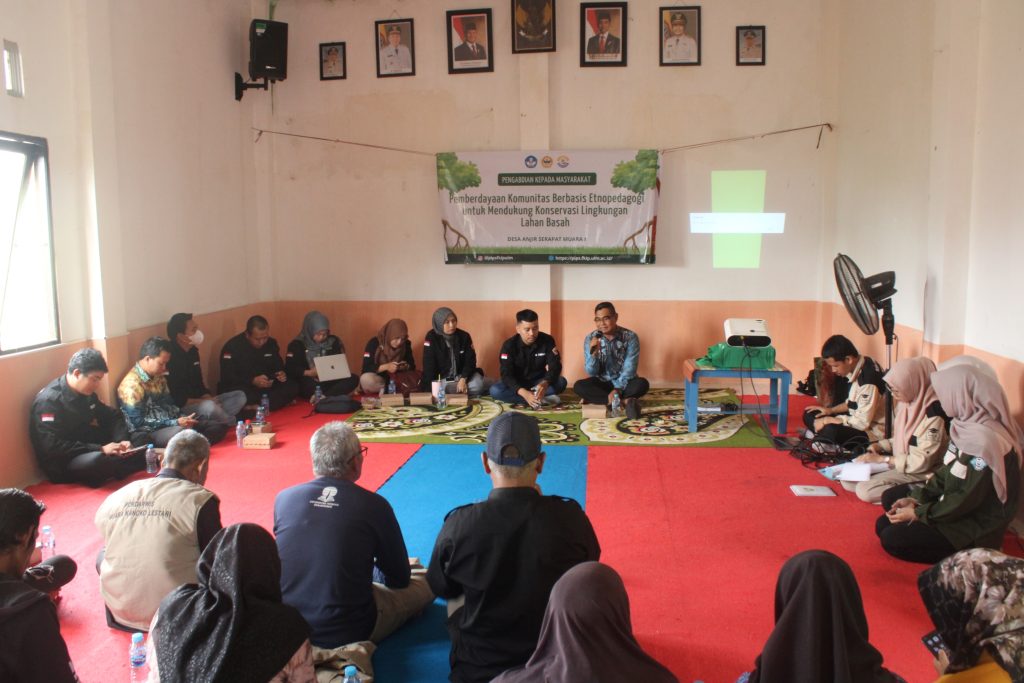
The active role of Universitas Lambung Mangkurat (ULM) academics once again manifests through community-centered initiatives that directly respond to local environmental needs. Ridha Ilhami, M.Pd, lecturer of the Social Science Education Study Program, Faculty of Teacher Training and Education (FKIP ULM), carried out a Community Service Program in Anjir Serapat Muara 1 Village, Barito Kuala Regency, focusing on strengthening community capacity in preserving wetland ecosystems through an ethnopedagogical approach.
With the theme “Community Empowerment Through Ethnopedagogy to Support Wetland Environmental Conservation,” the program represents a concrete contribution of Social Science Education lecturers in applying social science knowledge to address environmental issues in South Kalimantan.
The Head of Anjir Serapat Muara 1 Village, Kaspul Anwar, officially opened the activity and expressed his deep appreciation for the presence of the ULM Social Science Education team. He highlighted the strategic significance of this initiative, noting that the village serves as a buffer zone for Pulau Curiak, the habitat of the proboscis monkey (bekantan) and a vital center for wetland conservation in the region.
As the main speaker, Ridha Ilhami, M.Pd emphasized that Social Science Education plays a crucial role in shaping environmentally responsible behavior within communities, particularly by grounding learning in local wisdom. He explained that ethnopedagogy allows the integration of cultural values intrinsic to wetland communities—such as mutual cooperation, wise use of natural resources, and adherence to local customs—into modern conservation strategies that can be directly practiced by residents.
The training session was attended by youth groups (Karang Taruna), women’s community groups (Ibu PKK), environmental activists, and fellow lecturers from the Social Science Education Study Program. Participants received material on wetland ecosystem threats, declining water quality, and the severe impacts of land-use change on the bekantan habitat. They were also guided to identify village potential and design community-based action plans to support sustainable environmental stewardship.
Interactive discussions enriched the session. Environmental activists shared their on-the-ground experiences in protecting the local area; Karang Taruna expressed their commitment to engaging youth in environmental education; and Ibu PKK emphasized the importance of household-based eco-friendly practices, including waste management and the utilization of organic materials.
Through this community service initiative, Ridha Ilhami, M.Pd reaffirmed that Social Science Education lecturers are not only educators within classroom walls but also agents of change who connect academic theory with real community needs—particularly in the context of environmental preservation in Batola.
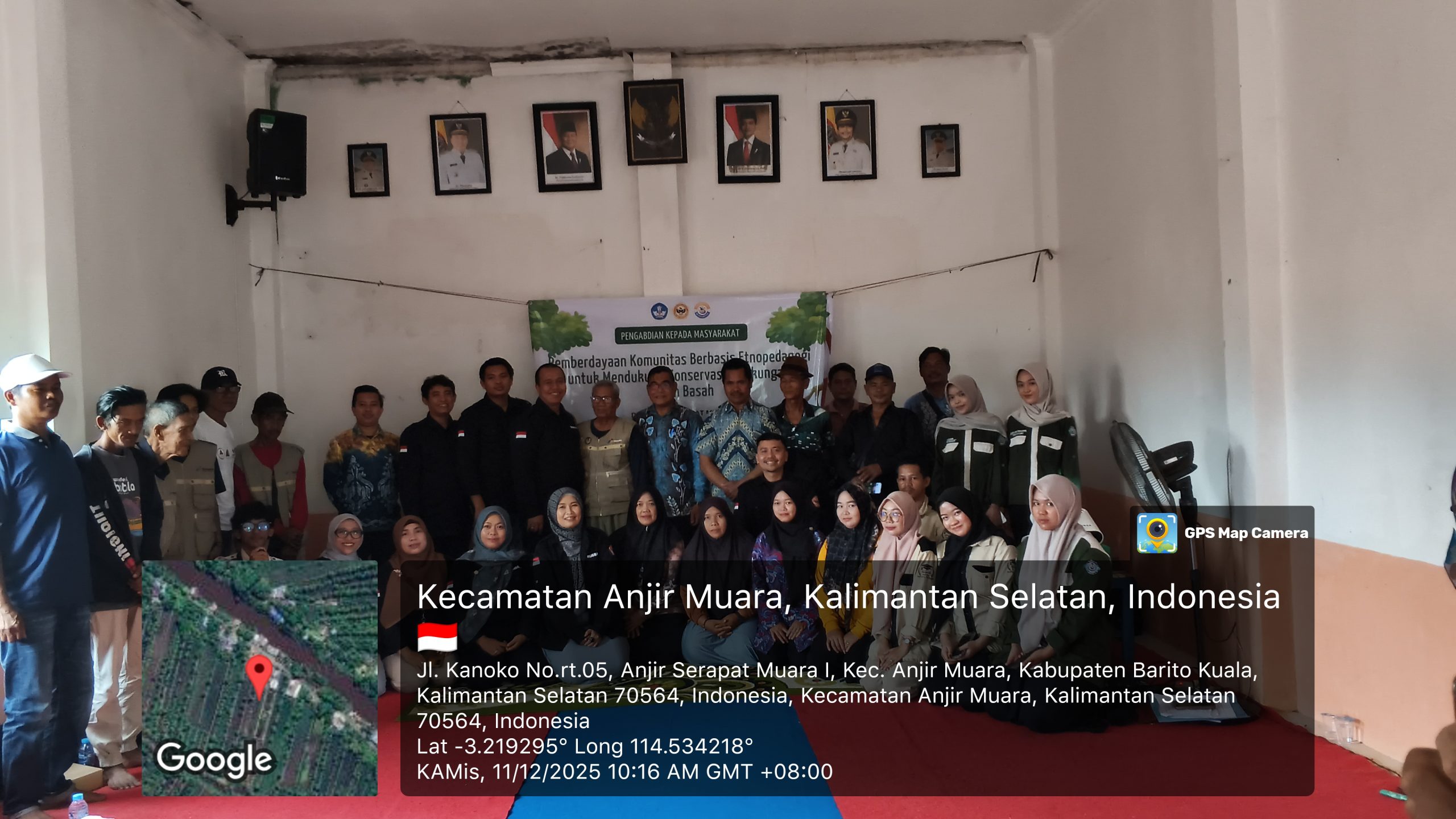
The program concluded with a group photo as a symbol of shared commitment to continue collaborative conservation efforts. The initiative led by the Social Science Education Study Program FKIP ULM is expected to inspire other villages in Barito Kuala to strengthen their environmental conservation movements grounded in local wisdom and communal values.


0-0x0-0-0-{}-0-0#


