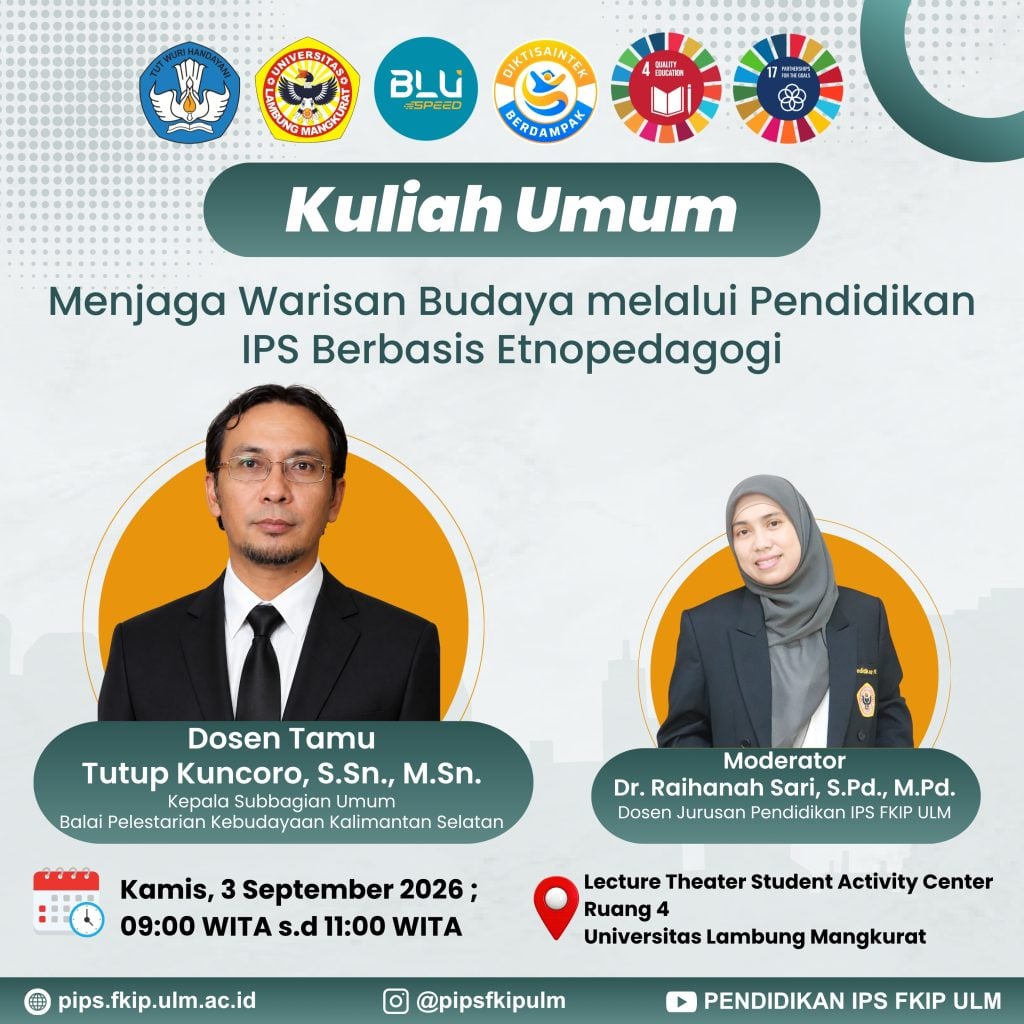
General Lecture: Preserving Cultural Heritage through Ethnopedagogy-Based Social Science Education

Social Science Education Public Lecture Highlights Cultural Heritage Preservation through Ethnopedagogical Education

Exploring Research, Documentation, and Education as Pathways for Preserving Cultural Heritage

September 3, 2026
Lecture Theater Student Activity Center (SAC) Room 4
Universitas Lambung Mangkurat, Banjarmasin

Public Lecture on Cultural Heritage Preservation

The Department of Social Science Education, Faculty of Teacher Training and Education, Universitas Lambung Mangkurat (ULM), held a public lecture entitled “Preserving Cultural Heritage through Ethnopedagogical-Based Social Science Education” on Thursday, September 3, 2026. The event was held at Lecture Theater Student Activity Center (SAC) Room 4, ULM, featuring Tutup Kuncoro, S.Sn., M.Sn., Head of the General Affairs Subdivision of the Cultural Preservation Office of South Kalimantan, as a guest lecturer.

The lecture was moderated by Dr. Raihanah Sari, S.Pd., M.Pd., a lecturer in Social Science Education. The discussion focused on the importance of understanding culture and preserving cultural heritage through research, documentation, and education.

Understanding Cultural Heritage through Research and Documentation

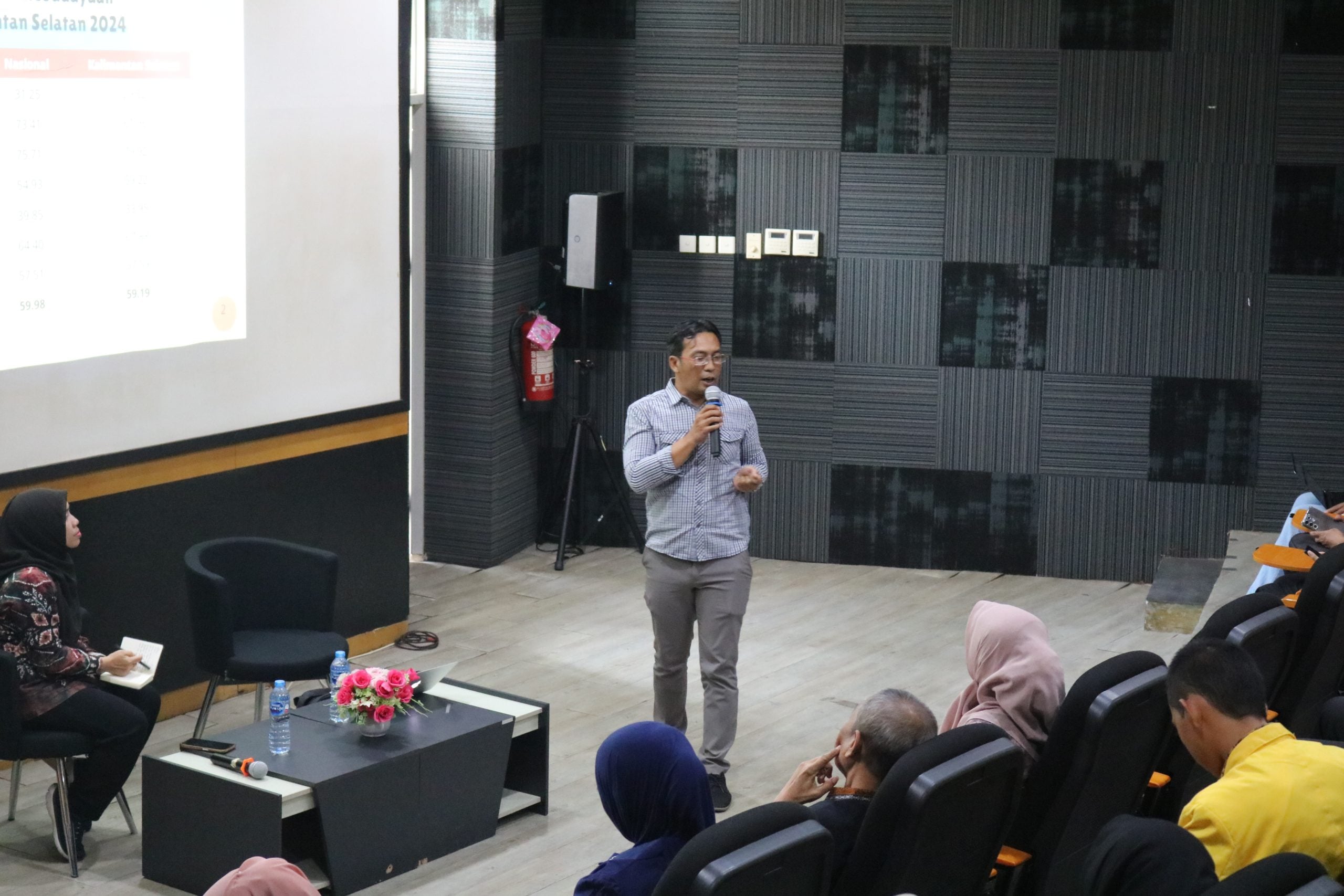
In his presentation entitled “Cultural Heritage Preservation through Research and Documentation,” Tutup Kuncoro explained that culture encompasses the creations, feelings, intentions, and works of communities. Cultural heritage is not limited to tangible forms but also includes intangible cultural heritage that lives, develops, and is passed down within communities.

The lecture introduced the ten objects of cultural advancement: oral traditions, manuscripts, customary practices, rituals, traditional knowledge, traditional technology, arts, language, folk games, and traditional sports. Understanding these cultural elements provides an important foundation for recognizing cultural richness and supporting preservation efforts.

Local Culture and Cultural Documentation
Traditional Knowledge

Mandau was presented as an example of traditional knowledge that can be understood through community experiences in interacting with the environment and through the intergenerational transmission of knowledge.

Cultural Documentation

Documentation through videos, films, exhibitions, and digital media can help younger generations recognize cultural practices and understand how cultural knowledge is transmitted across generations.

Ethnopedagogy as a Learning Approach

The discussion highlighted the role of education in preserving cultural heritage through an ethnopedagogical approach. Ethnopedagogy draws upon local cultural values, knowledge, practices, and wisdom as both learning resources and contexts. This approach can connect learning materials with students’ experiences and sociocultural environments.

According to Tutup Kuncoro, ethnopedagogical concepts can be applied across various fields of social science. Its implementation depends on educators’ ability to deliver learning materials and provide explanations that are accessible to students.

“The concept of ethnopedagogy can still be applied across all fields of social science. It depends on how we teach it and provide students with an understanding that is easy to grasp.”

— Tutup Kuncoro, S.Sn., M.Sn.

The Role of Students in Preserving Cultural Heritage

Tutup Kuncoro emphasized that culture is dynamic and can develop alongside changes in society. Students, as the next generation, have an important role in maintaining cultural heritage so that it can continue to be known and understood by future generations.

“Culture is dynamic, so as students, you also have a role in preserving it so that it can be seen by the next generation.”

— Tutup Kuncoro, S.Sn., M.Sn.

Video Documentation

Watch the documentation of the Social Science Education Public Lecture on cultural heritage preservation through ethnopedagogical education.

Contribution to the Sustainable Development Goals

The public lecture contributes to the Sustainable Development Goals (SDGs), particularly SDG 4: Quality Education and SDG 17: Partnerships for the Goals. The activity integrates cultural heritage, research, documentation, and ethnopedagogical perspectives into the learning process while strengthening collaboration between higher education, cultural preservation institutions, educators, and students.

SDG 4 — Quality Education

The activity supports quality education by enriching students’ learning experiences through cultural heritage, research, documentation, and ethnopedagogical approaches. Students gain opportunities to connect academic knowledge with local cultural contexts and develop a deeper understanding of culture as a learning resource.

SDG 17 — Partnerships for the Goals

The activity strengthens collaboration between higher education institutions, cultural preservation institutions, educators, and students. This partnership facilitates knowledge exchange and supports shared efforts to integrate cultural heritage preservation into education.

Strengthening Cultural Awareness through Education

Through this public lecture, Social Science Education students gained insights into the importance of research, documentation, and education in sustaining cultural heritage. The activity strengthened students’ understanding of local culture as an educational resource while encouraging collaboration among academic and cultural stakeholders in supporting meaningful and context-based learning.

Department of Social Science Education
Faculty of Teacher Training and Education
Universitas Lambung Mangkurat